Labels


Showing posts with label Technologies. Show all posts

Tuesday, 4 February 2020

NEW Game: Waters Edge


This is the first post in a series of game reviews, for those people who love 'gameschooling'.

If you're looking for a gift for someone special, one of these games may be the perfect thing.

In each post I'll review a game, give you the pro's and con's, and tell you who will benefit most from the game.

Waters Edge

We were lucky enough to get our hands on an advance copy of Waters Edge, a new game that's just launched.  You can pre-order a copy here.

We're not affiliated with Waters Edge, this is our honest opinion after playing the game.

This crowd-funded game is made by Scottish artist Catherine Redgate.  It's based on a cottage fishing industry, although you don't need to be fishing-mad to enjoy it.

After playing this game we had some great discussions about systems (inputs, processes, outputs) and sustainability (Australian Curriculum).

Pros

This game is complicated enough to engage adults and older children.

The artwork is simply stunning.

Although there is luck involved, it also requires some skill, which is a pro in my book.

Because there are a lot of cards, the game is quite different to play each time, depending on which cards come up most.

The playing time for us has been in the 25-40 minute range, which is perfect for a quick after-dinner round.  The playing time is determined by the 'time of day' and 'day of the week' cards.

The way the game operates - building up the lighthouse and shops, shifting fish between your boats, ice house and village - is really unique and fun.

It has a quaint, old-fashioned feel:  A throw-back to seaside communities of yore.

The cards and instructions are high quality and easy to follow.

It's made in Scotland but suits a global audience.

Cons

It's too complicated for early learners.

This game would lend itself really well to team play and it's a shame that's not how it's intended to be played.

Who this game is for

This game is perfect for fans of card games that involve an element of luck but also some decision-making.

As yet, we haven't had ANY sibling squabbles over this game.  ZERO!

We tend to have a problem in our house with games of pure strategy... After a certain point there is a bathetic descent, because certain people can't blame bad/good luck for losing/winning!

So if pure strategy games are a combat sport in your house, Waters Edge is for you.

There's a certain amount of decision-making about when to move fish and which cards to play, so you do get to exercise your grey matter, but there's enough luck involved to keep things light-hearted.

Waters Edge celebrates something that transcends ages and cultures:  The act of procuring food from the sea.


What are your recommendations for games?  We'd love to know in the comments.  

Thanks for your time.  Stay tuned for our next game review: The Ancient Egyptian Game of Senet.  In the meantime, try this post with our favourite maths games:  10 Maths Games You Don't Want To Miss.

x x Zoe


Tuesday, 14 May 2019

Sneak Peek In Our Techie Study

Today I'm going to give you a SNEAK PEEK at what's on our study desks and computer desktops - completely uncensored, NO hypocritical tidying right before the photos!  Yup, warts and all!

We have a lot of tech in our study, especially by global standards.  Let me stress that there's no point in having new technology unless you can use it to make the world a better place.  

Here's an overview of the space we have:


You can see we've got 3 desk zones; two have Mac laptops and one has a monitor which gets used with either a Raspberry Pi or Dr Dad's work laptop running Linux.

There's actually a Raspberry Pi sitting there at the moment, which the boys have been playing Minecraft on programming.  That little doovalacky next to it is a random part for Dr Dad's boat.


On the first laptop: 


Below the desk is our modem and a NAS (Network Attached Storage) which has all of our music on it.  We use a wireless Sonos in our living room and we also have Spotify.  Spotify means less waste in the form of CDs that eventually end up in landfill.


On top of the desk we've got one of our Kindles charging, and Roo's motion-activated camera for bird-watching.


We've got a basic printer-scanner and a gift waiting to be sent.


I display a photo of my grandfathers who have both passed away...


... and a photo of S-Man being presented with a certificate for high achievement by the Minister for Education.  That was a slightly bizarre but kind gift from our school.

We've got a couple of trophies and a jar with loose change, too.


On the second laptop:

  • A graph of the Collatz Conjecture that Dr Dad and S-Man programmed together
  • A Python program S-Man wrote to generate prime numbers to 10,000


Next to it there's a plant Roo bought himself with pocket money...


... and a couple of textbooks I recently purchased secondhand on Gumtree for S-Man.  I like the Jacaranda textbooks best, but the Pearson ones are usually pretty good too.


The 10/10 signs were made by Roo so that his Fuzzy Bunnies could judge S-Man's piano practice.  They rated him unanimously 10/10.  Nice Fuzzy Bunnies.

Finally, there's a pair of cycling duds waiting to be mended, and under them a counter for tallying up piano practices which S-Man soldered from a Jaycar kit (a gift).


Oh, and I almost forgot: There's a beautiful ceramic Kelp Gull made by Roo, which is waiting to be fired.


That gives you an idea of what tech we have at home and which websites we're using right now!

Thanks for reading this warts-and-all peek into our study, and if you liked this, check out my video tour of our STEM playroom for some inspiration!

What tech do you and your family use?  Please let us know in the comments!  And if you like our blog, please share using the button below :-)

An Awesome Afterschooling Formula


Here's the simple and effective formula I follow for our home education adventures.  Let me outline the components, with three examples.

I'll give you an infographic first, for those who prefer to digest information in that way.  Then I'll go into more detail with 3 examples that you can try at home.


Using this formula, the learning really sticks.  Plus, it's fun!

Now, let me give you some awesome examples you can use.

THE HOOK

The main point of the hook is to get your child asking questions.

Sometimes I do more than one tuning in activity.

Hook Example 1:

The first example is a mystery; a 'Dr Dad for PM' sign appearing in the window of our house one day.


With an election coming up, and the Australian Curriculum requirement to cover Federation for my Grade 6 son, I had a vague idea that I wanted to take my kids to see Parliament sitting.

At this stage, I hadn't assessed their prior knowledge or come up with any firm learning intentions.

Remember, the hook doesn't have to do anything except get them interested!

Hook Example 2:

Again, I had no real idea of what the learning goals would be, but I knew I wanted to do a hands-on activity dissecting a sheep's heart.  I wasn't sure if my kids had any idea about veins, arteries or how hearts work.

The hook in this case was an interesting resource in the form of a fun lift-the-flap book on the circulatory system, which I put on display in our living room.


Hook Example 3: 

Sometimes the best hooks are simple open-ended questions, like when we drove past a tower and I asked, "What do you think this tower is for?" 

THE FIELD TRIP

A field trip takes the learning into the real world.

Before the field trip we usually discuss any questions we have that we want answered.  This is when I assess their prior knowledge and firm up learning goals.

It's a great Visible Learning strategy backed by research to be very explicit with your child at this stage about what they will learn, how they will learn it, and how they will know they have learnt it.

Field Trip Example 1:

The 'Dr Dad for PM' sign sent us off to see Parliament sitting, with the intention of learning what the different roles in Parliament are and who currently fills those roles.

Field Trip Example 2:

The book about the circulatory system took us to a medical museum with the intention of learning about the history of heart surgery.

Field Trip Example 3:

We visited a Shot Tower with the intention of learning when, how and why shot was produced in that way.

THE HANDS-ON ACTIVITY

This is a really, really essential component for me.  

The hands-on activity is less about knowledge, and more about creating a fun memory linked to the knowledge.  It really helps to develop a positive orientation towards learning.

Hands-On Example 1:

My son made this beautiful mace after seeing one on a poster we got at Parliament House:

Hands-On Example 2:

We dissected a heart after reading about the circulatory system:

Hands-On Example 3:

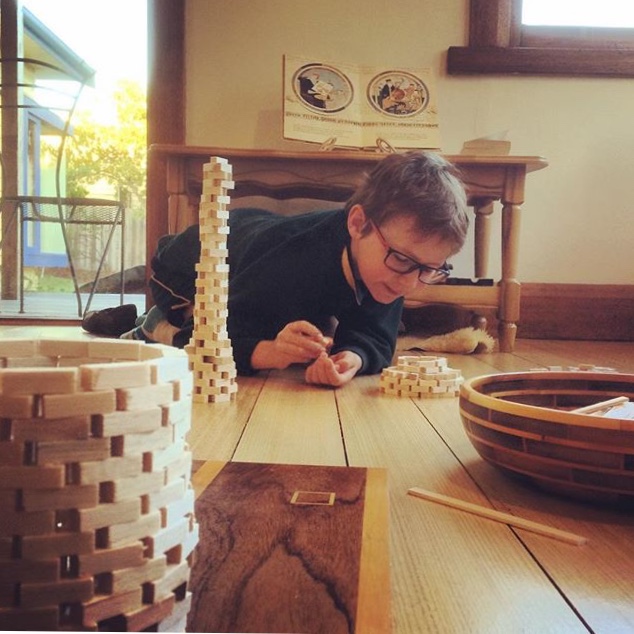
We built towers after visiting the Shot Tower.

I don't always do these components in order.  Sometimes the hands-on activity makes a really good hook, so we do that first.

If you want to see some examples of when I've used a hands-on activity as a hook, try our Cactus Invitation To Play or our Poo Provocation.

IN CONCLUSION

The three essential components of our afterschooling formula are a hook, a field trip and a hands-on activity.

Now it's your turn.  What do you think?  Please hit me up in the comments.

Stay tuned for another example of this formula in action with a post coming soon: 'This Is WAY Better Than Flashcards!'


Sunday, 27 May 2018

What On Earth Is WADD?! Part 1


June 17 is WADD.  Aren't you excited?!

"Hang on," I hear you asking, "What exactly is WADD?"

That's pretty much what Dr Dad said last year, on the occasion of the inaugural WADD.

We spent the month leading up to June 17 evading his questions, however I'll spare you that process and just tell you straight up that WADD stands for...


We Appreciate Dad Day

It all started when I discovered my son reading an old book that I absolutely LOVED in my childhood, Secrets with Ciphers and Codes by Joel Rothman and Ruthven Tremain.


The night before WADD, after my other half was in bed, I covered the kitchen table with balloons, taped streamers across the door, and left him this coded message that the kids and I had created on the computer (Australian Curriculum, Year 3 and Year 4):


Before he could eat breakfast, he had to decode it.

"We Abbreviate Dad Day?" he said.

Each message from that first one led to a different part of the city that was special to him, with a different gift hidden at each location.


You can probably guess that the first one was at the Frog Ponds.


Number 2 took him to what he calls The Friendly Spot, a beautiful jetty.


The next one took us to the sailing club (Frog In A Blender is one of his previous boats).


And the final clue was really, really obscure... too obscure... but it took us back home, where we had a lovely dinner and mini-party.

SO...

It's almost time for WADD again... and I have a ripper of an idea to surprise him!  Stay tuned.

We invite you to celebrate the dads in your life with us!  Spread love in the world!  Please let us know in the comments your ideas for making your dad feel special.

If you liked this idea, try a fun family outing using our Leaf Hunt Printable, or How To Make Someone Feel Special For A Year!

Sunday, 20 May 2018

Quest For The Best Bird Feeder


My son is learning about the needs of living things (Australian Curriculum, Year 1) so we've been creating bird feeders.


We tried a Cheerios bird feeder, but I was concerned Cheerios are not the most natural or healthy of foods for birds, so we took it down.  It only seemed to attract ants, anyway.


We also made a toilet roll feeder using peanut butter and wild seed mix.  It all washed off in the rain.


Next we tried an apple, still using peanut butter.


Finally we were able to eliminate the peanut butter altogether with this beauty made from a butternut pumpkin.


The pumpkin is definitely the model we'll use again.

UPDATE MARCH 2019:  Roo made a wooden bird feeder with his grandfather, which Dr Dad and S-Man mounted on an old boat boom in our backyard.  We use sunflower seeds and lorikeet nectar, both found at your local pet supply store.


Do you have any bird feeders in your garden?  What's the best model you have found?  Have you made any other design & technology creations? Please share with us in the comments!

If you liked this post, you might also like a tour of our STEM (Science, Technology, Engineering and Maths) Playroom.

Monday, 15 May 2017

STEM Playroom Tour


Even if you don't have the luxury of a playroom, you can make a few simple changes to help your child get excited about STEM (Science, Technology, Engineering and Mathematics)!  Here are our top tips.


1) Inventions Box filled with recyclable odds and ends (more info here);


2) Pegboard with bags of dollar shop goodies (making use of vertical space);


3) Clipboards and pencils available for planning and documenting.


To find out how we have set up our STEM playroom, or to get recommendations for a couple of our favourite STEM materials, please watch the room tour!


I'd love to know your suggestions for encouraging your children to experiment with STEM! Please share in the comments!

As always, thanks so very much for reading and watching!

If you like our STEM Playroom, you might like our post on different ways to make bird feeders (a design and technology challenge) - coming soon.  If you're looking for more organising tips, check out what we packed to go Worldschooling for three months, or how we organise our piano learning.