Labels


Showing posts with label Personal and Social Capability. Show all posts

Sunday, 19 May 2019

20 By 20 Bucket List


Are there certain things you want to do with your kids before they grow up?

Lately I've been encouraging my sons to make their own '20 by 20' bucket lists.

Learning how to set and achieve goals is part of developing personal and social capability (Australian Curriculum).

My older son, S-Man, just ran his first 12K trail run, and next he wants to learn Chinese.

My younger one, Roo, wants to hand-tame a wild bird, and to learn to ride a horse.

Here's my '20 by 20' of things I want to do with the kids before they leave home.

1.  Ride scooters on a jetty

I don't know what the appeal of this is, but I guess it's the risk of falling in the drink!

2.  Sleep out under the stars

I'm picturing either the involvement of a trampoline, or a beach.  Or both.

3.  Travel to Asia

I want to take them to my old hometown in Indonesia, where people might not have dishwashers and vacuum cleaners and electric washing machines, but they're still happy, kind and generous.

4.  Travel to the nation's capital

Visit the hallowed halls of Parliament, check out the galleries and War Memorial, visit Questacon and the Mount Stromlo Observatory, plus tour the miniature world of Cockington Green.

5.  Visit Savoy Baths

Even kids deserve to relax, unwind and be pampered.

6.  Swim at night, in the dark

In the dead of winter!  Brr!

7.  Give them a 'Yes Day'

My kids love it when I do this.  It's when I say yes to any request (within reason).  Ice cream for breakfast?  Well...  yes!

8.  Be craned up and dropped into a giant Finnish blueberry pie

Okay, I concede this one might be impossible.  But we could pick wild blackberries for pie.

9.  Grow native plants for food

We've really been inspired by this book: Eat Wild Tasmanian.

10.  Teach them to ski

I'm a pretty crap skier myself (snow plough all the way) but skiing is way too much fun to miss.  Plus: hot chocolates.

11.  Celebrate Christmas in July

Reindeer.  Pine trees.  And more opportunities for Finnish blueberry pie.

12.  Ride bodyboards down the dunes at Crescent Beach  

This one is super scary.  I'll just close my eyes.

13.  Watch a marathon of Pinky and the Brain episodes

I just love how Brain fails every time in his evil plans to take over the world, but he never gives up.  #motivation

14.  Read aloud to them while they still want me to

Nothing marks the passing of time more than when it's you asking your kids to read.

15.  Slide down a banister

Somehow, this is just something we've never actually done.  How did we miss that??

16.  Take Annie The Destroyer to more cafes

Annie is our exuberant dog.  Not a designer dog at all.  Much scruffier.  Taking her to posh cafes is like taking one of Hyacinth Bucket's uncouth relatives.  But the kids love it!

17.  Force them to watch a slideshow of all 15,428 baby and toddler photos

This one I'm saving for their 18th birthdays, especially because about 14,999 of those photos are embarrassing.  Seriously though, what's the point in taking all those photos if you never look at them?

18.  Create 'Mum's World' in Minecraft and whip their behinds

Believe me, I know everything there is to know about Minecraft TNT cannons.  I have listened until my eyes bleed and my ears explode.

19.  Teach them to use chopsticks

S-Man has finally got it.  Roo... not so much.  Does using it like a Harry Potter wand count?

20.  Write them a special letter, to tell them how much I love them

You can read my Open Letter To My Children here.

What's on your 20 by 20?  I'd love to know your ideas.  Have you done any of the above ideas already?  Please let us know in the comments (especially if you've been dropped into a pie).


Friday, 17 May 2019

How One Kid Is Changing The World! 8 Ways You Can, Too


What would you change about the world?

What do your children want to change?

My son Roo is trying to change the world, one lip balm at a time.

He's donating the profits from his care products to charity.

Wouldn't it be great if we could eradicate hunger, end war, and ensure everyone the world over has basic human rights?

These issues seem so impossibly big and beyond one person to solve.  It's hard to stay active on these problems year in, year out.

Working together is our best bet!

What can we do to make the world a better place?


1.  Be a good bystander

Stand up for others when you see everyday injustices occurring.

2.  Spread the word

Use your social media networks to bring awareness.  Start conversations.  Like this one!

3.  Write to your pollies

Politicians get a bad rap, but actually most of them love hearing about the issues important to their individual constituents, and will take on board what you say.  It's also super easy to sign online petitions.

4.  Invest ethically

Companies like Australian Ethical use your superannuation for good.  It takes a bit of admin work to set up at first, but then you don't have to do anything except feel satisfied.  They perform well, too.

5.  Get your kids involved

My favourite resource for kids who want to change the world is ruMAD?  (Are You Making A Difference?)

6.  Volunteer

Help out at a local school, do some gardening for an elderly neighbour or relative... there are possibilities to suit everyone.  Volunteering makes you happier and healthier.

7.  Spend money wisely

Do you really need that new doozy-whatsit?  Do you know whether it is produced ethically?  Check out this App to help you put your consumer dollar to work.

8.  Reduce your waste

Drive less, turn the heater down, compost leftover food and take your own bags and containers to the supermarket.  Choose seasonal produce without all the plastic rubbish and high food miles.

8.  Donate a percentage of your income

Between 1 and 10 percent is a good amount.  The Effective Altruism website helps you select the best charities.  On Dr Dad's side of the family we make an annual donation instead of Christmas gifts.  Join a cause (or causes) that you care about and make a regular donation.


Over to you.  What would YOU change about the world?  
Let's DO it!

Thanks so much for reading.  Looking for ways to develop personal and social capabilities in your child?  Start with A Little-Known Fact About Kids' Heroes.

Shout out to Amnesty International for some of the ideas on this list!!


Tuesday, 14 May 2019

Why I'm A Pushy Mother

We all just want our children to be happy, but what exactly causes happiness?

And what causes high life satisfaction?

Friends, family and hobbies are the first things that spring to most people's minds, but they're only part of the picture.

Research by Churchill Fellow Michele Juratowitch has uncovered something fascinating:

For 'gifted' students, happiness = challenge.

Michele explains that when challenged, students enter a state of flow that is associated with increased happiness.

So why do some people underachieve, leading to poor self-reported life satisfaction?


Juratowitch thinks Gagne's model provides some insight into the problem.

Some children might not experience the environmental support, interpersonal catalysts or optimal developmental processes to derive maximum 'talent' from their innate 'giftedness'.


Unfortunately, Michele points out, in Australia there is an even more subtle reason for academic underachievement.

Researchers in Australia and the USA have tested personality profiles for acceptability and found that...

  • 'Average intelligence + non-studious + athletic' = highest acceptability
  • 'Brilliant intelligence + studious + non-athletic' = lowest acceptability
  • BUT 'brilliant intelligence + non-studious + athletic' ranks highly.  

Juratowitch was quick to point out that these findings apply to Australia and the USA, not necessarily to other cultures.

So, academic achievement might be sacrificed for social integration, in Australia at least.

Maybe that's okay, if social integration is more important to you than academic achievement.

But it's sad when people experience lowered life satisfaction as a result of underachieving, or less happiness due to a lack of challenge in their lives.

There must be a way to have both social integration and some studiousness.

I discussed this with my Year 6 son, S-Man, and he approached it from a mathematical and evolutionary point of view, relating it to left-handedness.  Read Woo's Wonderful World Of Maths to learn more about why left-handedness confers an evolutionary advantage but isn't dominant in our society.

If you want to learn more about the complicated field of experienced happiness and life satisfaction, I highly recommend Thinking Fast and Slow by Daniel Kahneman.

I also urge you to attend one of Michele Juratowitch's workshops if you get the chance, for a much more in-depth look at the issues.

After the fantastic seminar by Juratowitch, I had a conversation with S-Man about where he might want to head next with his maths education, so that he remains challenged.

"I don't want to push you," I said, "I want you to take all the time in the world with your education and to really enjoy it.  There's no rush.  I don't want to be a 'pushy mother'."

His reply was immediate and vehement, and wouldn't have surprised Juratowitch one bit:  "No, push me, push me!  I want to be pushed, mum!"

By which I think he really meant I WANT TO BE CHALLENGED!

I have great faith in my children and in children in general.  I trust that if we challenge them and give them some responsibility they will rise to the occasion.  And they'll be all the happier for it.

Can you be TOO involved with your child's education?

My opinion is yes, you can!  That's called 'doing it for them'.  Or living vicariously through them.

We parents don't need to do school, we've done it.  Now it's their turn, to make their own mistakes and figure out how to rescue themselves from them.

It's only fair that parents should get to have a life.  I want to work at my paid jobs, spend time with my grandmothers while they're still around, catch up with my friends, exercise, engage in my hobbies, make the world a better place, not to mention carry out the necessary tasks of scaling Mt Washington, picking up dog poo, and putting nutritious meals on the table....  like beer mousse...  mmmm... beer mousse...

Actually the beer mousse was disgusting, but I digress.

Speaking of chores, one final point worth noting on the topic of happiness is that adults who report having done chores as children are actually happier.  It pleases me to quote that at my children on a regular basis!

Thanks for reading, and please let me know your thoughts in the comments!  Are YOU a pushy mother?

Looking for ways to develop personal and social capababilities in your children?  Head on over to this post.

A Little-Known Fact About Kids' Heroes


Who were your childhood heroes?

Although this fact is not well known, the type of hero you had as a child is linked to your adult happiness.

One of my heroes is my grandmother, who taught me, "It's nice to be important but it's important to be nice."

I asked my son who his hero is and he said, "Parpie."  That's my grandfather, who was a prisoner of war.

So which people make the best heroes for kids?

How many heroes should we have?

Is it okay to hold celebrities up as heroes?

Which kids' heroes promote happiness and success later in life?


It turns out that children whose heroes are personally known to them are more likely to achieve life satisfaction as adults.

Also, there's a protective factor in having a number of heroes rather than just one.


A psychologist once told me about the Five Fingers exercise:  Ask your child to come up with 5 people they could turn to in a crisis, including at least one outside the family.

That exercise could easily be applied to heroes, too.


To expand my children's repertoire of role models, we watched this great BTN special about Dr Douglas Mawson, who contributed hugely to science and also survived an incredible Antarctic ordeal.

We took a trip to the replica Mawson's Hut to really imagine ourselves in his shoes.

For a follow-up, I'm going to get the kids to plan our next intrepid winter expedition.

How much food and water do we need?  What will we take to keep warm?  Which personal qualities will help us to survive and thrive?

Who are your children's heroes?  Do you know any heroic human beings we can learn about next?  Please share in the comments, we love to be inspired!

Our Mawson field trip follows a simple but awesome afterschooling formula.  To learn more, check out this post.  New to afterschooling?  Try our A-Z of Afterschooling.


Friday, 10 May 2019

Open Letter To My Children


Is the death of your loved ones your biggest fear?  It is for me.  The way I cope with it is through preemptive nostalgia, as in...

"One day this precious time will be gone and all I'll have is memories..."  (Cue the sound of a melancholy saxophone.)

Did you know that people who engage in nostalgia a few times a week are actually happier overall?

It seems that nostalgia has an evolutionary purpose and is a protective factor.

The other day I was dwelling on my children dying and then it hit me:

I am going to die too.

Sooner or later there will be a zombie apocalypse and I'll become one of the undead.

So I decided to write a letter for my children to read when I kick the bucket.

This isn't really an afterschooling activity, except that it might give my children greater resilience in the future, and support them in developing personal and social capability (Australian Curriculum).

My letter isn't going to win any literary awards, but it's from my heart.

By the way, I'm sure I've plagiarised bits and pieces from things I've read that have stuck in my memory.  If you come across any of the content elsewhere please let me know in the comments so I can give due credit.

Without further ado, drum roll please...


"Dearest S-Man and Dearest Roo,

If you're reading this, that means I'm dead.  Oops.  My bad!  I'm truly sorry about that.  I planned to live forever, but, as they say, life is what happens while you're making other plans.

I love you.  I love you forever.  I love you to infinity.  I love you to the ends of the universe, deeper than the ocean and brighter than the sun.

When I tell you I love you, I don't say it out of habit or to make conversation, I say it to remind you that you're the best things that ever happened to Dad and me.

I love you like a summer night, like a cosy winter campfire, like toasted marshmallows, like running through a sprinkler!

What advice can I share with you?  None, really.  My job is done.  You are already everything I could've hoped for and more.  You are the finest, loveliest, tenderest and most beautiful people I have ever known and even that is an understatement.

If I must come up with some advice, it would be this:  Slide down the banisters!  Blow bubbles and chase them!  Never miss the chance to bounce on a trampoline!  Walk barefoot, listen to the wind, drink in the moon!  

And it is absolutely okay to fail.  At anything and everything.  Big stuff and small stuff.  It's okay if the only thing you did today was breathe.  

You see, the love you have given me, THAT IS MORE THAN ENOUGH.  You've made my heart sing with happiness, made my bleakest days shine, been the rainbow in my cloud and made my life complete.  Cheesy, but true.  

I couldn't be any happier, and it is thanks to the love you have given me.  May all those smiles you've bestowed on me be returned to you, and all the cheerful words you've said to me be spoken unto you!

Everyone has those days when you doubt yourself, and when you feel like everything you do sucks.  Don't be so hard on yourself.  Remember the mum in E.T. had an alien living in her house and she didn't even notice.  

In nature, nothing is perfect and everything is perfect.  So it is with humans.  You will be wounded, and you will wound.  Forgive yourself.  And please forgive me.  As Leonard Cohen says, "There's a crack in everything, that's how the light gets in."

Here's a little song for you:
"I'll love you forever,
I'll like you for always,
As long as I'm living,
My baby you'll be."

Well, actually, even after I'm dead you'll still be my babies.

I'm preparing some little presents for your future birthdays, which I intend to put in a box in the roof.  The thing is, they're really just stuff.  But you:  You are my home, and my adventure, all at once.  To quote Walt Whitman:  "We were together.  I forget the rest."

In the end, I needed so little to be happy:  Sunlight on the mountain and your hands in mine.

Thank you.

Cuggles and kisses,

Mum.

PS - S-Man; guys reading are glorious!  Roo; you'll always be my god of laughter and dirty tricks!"

I added this pic from Winnie the Pooh:


What would you put in a letter to your children?  Please tell me in the comments.  And if you liked my letter, please share it using the buttons below!

Saturday, 26 May 2018

Personal and Social Capability: Caring Punches


A fear many parents have - myself included - is that our children won't develop the personal and social capability needed to thrive as adults.  

We want them to achieve at least some of their hearts' desires, to find love and to be fulfilled in their careers.

We worry that they'll be 35 and still flicking boogers at their brother.  (Er, maybe that's just me.  Is that just me??)

So, how do we ensure they develop those capabilities?

Following is what we do in my family.  I'd love to know what you do in yours.


1. Identify shared values

When our children are babies it's hard to involve them in family decisions, but as they grow I think the aim should be to encourage their input.

Some years ago I gave each family member a list of possible values (like this one here) and asked them to individually circle their top two.

Then we came to a consensus regarding our family values.  We chose fun and peace.

It's okay for individuals to have different values, but it's great to find some common ground.

S-Man, who was in about Year 2 at the time, surprised me by writing this beautiful message on his chalkboard:
"Fun and peace make our lives complete!"
Or actually it was...
 "Fun and peas make our lives complete!"
We talked some more about what peaceful people do, and we decided to add caring as a value, too.

Living your values sets a good example for your kids.  Many people do this through churches or service projects.  Two great resources I've seen for young people in this area are ruMAD? and Expedition Class.

2. Explicitly and directly teach skills

This is an on-going process from birth and it requires modelling, using I-statements, and empathetic listening.  There's plenty of evidence for the effectiveness of direct instruction, but it hasn't come naturally for me and it's something I'm still working on.

Because our school uses the Zones of Regulation, I'm trying to use them at home.  The program helps children become aware of their emotional states and move between Zones.

During the school holidays I sometimes print out worksheets that focus on social and emotional skills, such as...
My kids roll their eyes, but usually end up doing the odd worksheet when they get bored!  Some kids would hate this: You know your child best.

We also occasionally use this great ACARA blog with lots of inspiring and useful videos.


Warm family time spent together doing enjoyable activities obviously helps, which is the reason I started planning fun activities like this Harry Potter Invitation to Play.  But afterschooling activities are just one way that works for us, many families have their own ways to bond. 

3. Develop a system for recognising desired behaviours

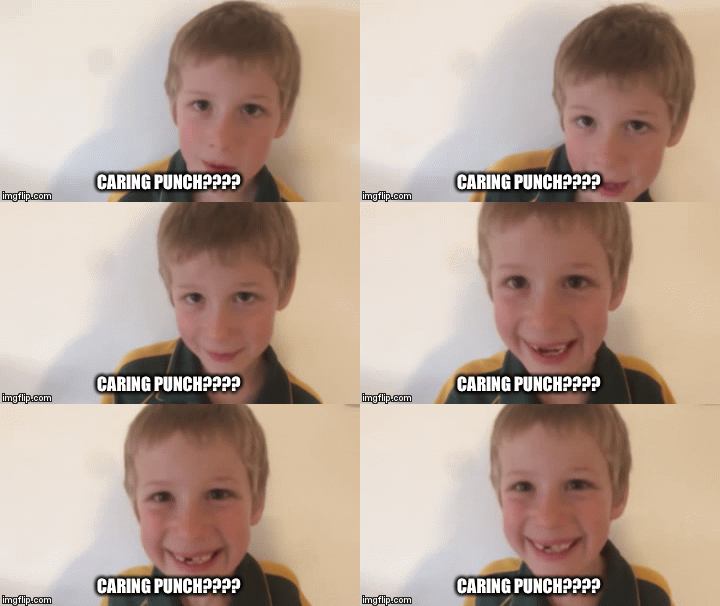
We use 'Caring Punches'.  Nothing violent!  Just a simple card and hole-punch system.

Every time our kids are caring or resolve disputes peacefully we get them to give themselves a hole punch on their cards (which are kept on the fridge).


The main value in doing this is really just that it reminds us, as parents, to catch them doing the right things and to keep it positive.

For the first few years of doing this we had a reward of half an hour of screen time, but we've recently increased the overall screen time our children get, so we phased it out in favour of a family outing or special family time together.

There are downsides to having a reward:  Obtaining the reward becomes their primary focus and it reduces intrinsic motivation.  Rewards and punishments can devolve into a controlling parenting style which research shows can have negative outcomes.


4. Conduct family meetings on a regular basis

Family meetings are a good opportunity to bond, to coach and to air issues.

In our family anyone can call a family meeting, and this is the format we follow:
  • Each family member thanks or compliments the others 
  • Any issues are raised and discussed
  • We finish with a joke or funny story
Roo still finds it difficult to give compliments and express his issues, but he enjoys jokes!  His favourite:
"What do you call a deer with no eyes?  No idea!" - Click to Tweet if you're brave!
We often have family meetings on a Thursday, because that's also the day I do my menu plan for the week and I like to ask the kids what they want to cook during the family meeting.

5. Develop a system for dealing with unwanted behaviour

We use 1, 2, 3:  Two warnings and then a consequence of loss of screen time for a day.  But that's rare.

All this is just what we use, and I'm by no means an expert, just sharing, in the interests of starting a conversation and hopefully improving my own parenting.

If you have serious issues, consult a professional.  We have done that before and it was great.  Working with your school is also a fantastic way to ensure everyone is using the same strategies!

Making the world a better place starts at home.

So, to develop personal and social capability in our family, we use a combination of direct teaching of skills (I'm not great at this), shared values, punch cards, family meetings and 1, 2, 3.  I can't wait to get your ideas.  Please tell me in the comments! 

If you liked this post, you might also like How To Make Someone Feel Special For A Year.